
How it feel like to live with clubfeet
How hard or easy to live with this disease will heavily rely on how serious your symptoms are. I’ve heard that some people have troubles staying up on their feet more than a certain amount of time before being too painful (again, that can vary). I also heard some people having problems while descending stairs. I won’t even talk about the people that didn’t receive any treatment at all (mostly in third world countries), and just had to live around it.
So as I mostly do on my blog, I will talk about my own experiences. Like I’ve detailed a bit in the about page, clubfeet have 2 impacts :
- Mechanical one
- Esthetical one
In this post, I’ll focus on how the mechanical aspects of the disease, how it affects me in my daily life, and give more insight in each discipline of triathlon.
What makes my legs different :
- Very low muscular power in my calfs
- Decreases a lot the power needed to cushion shocks
- My overall stability to the ground is very low : if you try to push me, it won’t need much force before I can’t stand my position
- Very low proprioception
- I’m unable to stay long or be confortable on one leg for example
- Very low mobility of the ankle
- If I try to do a squat, my heel can’t touch the ground at all
In the everyday life, it is not a big deal for me, you just learn to live around it. This is your body, you’re born in it, and you don’t know what walking feels like on normal legs. However i do have my own theories on how my body worked around that issues.
For example I had an hint right in front of me all this years : my thighs are rather big : their circumferences are around 60cms. Here is the average size for men and women in the age group 20-49, to help you compare :
| Percentile | Men | Women |
|---|---|---|
| 5th | 18.2 inches (46.3 cm) | 17.0 inches (43.3 cm) |
| 10th | 18.8 inches (47.7 cm) | 17.7 inches (45.0 cm) |
| 15th | 19.3 inches (49.0 cm) | 18.2 inches (46.2 cm) |
| 25th | 20.1 inches (51.0 cm) | 18.9 inches (48.1 cm) |
| 50th | 21.4 inches (54.3 cm) | 20.6 inches (52.4 cm) |
| 75th | 23.0 inches (58.4 cm) | 23.0 inches (58.3 cm) |
| 85th | 24.0 inches (61.0 cm) | 24.2 inches (61.6 cm) |
| 90th | 24.8 inches (62.9 cm) | 25.4 inches (64.5 cm) |
| 95th | 26.1 inches (66.2 cm) | 27.3 inches (69.4 cm) |
To me it actually explains a lot of small things.
As my thigs are not affected by the disease, they could grow normally. So what would they grow above average ? My theory I that I use them a lot more than the average person. Since my calfs can’t provide the necessary power to achieve all this actions, my body found a way to work around it.
For example, If I walk, I’ll activate my thigs. If I try to stay on one leg, my thigs will be activated, etc… Because I’m activating them more than the average person, they grew more. I guess you can try to feel what I feel : try to walk but using only 5/10% of your calfs power, (you can imagine you have very bad cramp there and you barely can use them). You will naturally activate the muscle you have left :-).
Beside the lack of muscular power in this specific region, which already affects a lot of functions, the other main issue is the flexibility of the ankle itself. I’m not able to put pressure and flex a lot in the front, before having my lift my heel. I’ve followed a very scientific approach to demonstrate this issue, this is my girlfriend’s ankle max flex :
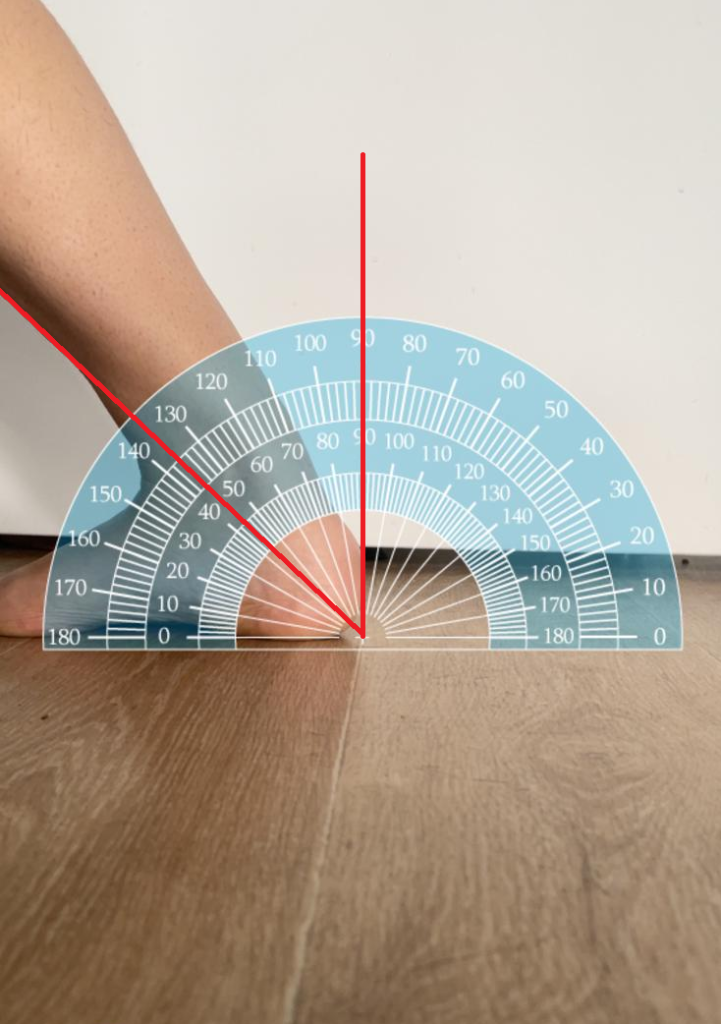
Here I measured 45 degree from the tip of the back of the heel, to the part of her leg that is at the further front.
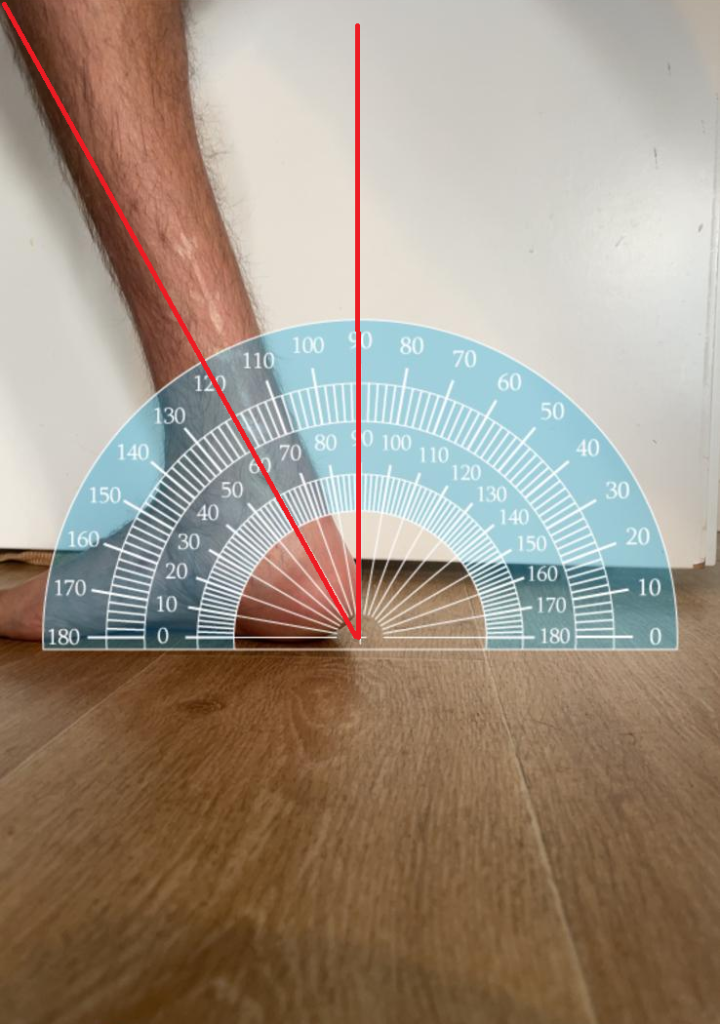
Here I measured 30 degrees, so around 15 degrees less.
There is another way to measure the maximum front ankle flexion : Weight Bearing Lunge Test. You stand in front a wall, your knee must touch the wall while your heel is still on the ground, and you try to put your foot as far as possible :
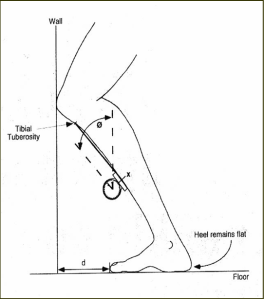
Then you measure the distance between your front toe and the wall.
Based on a study made by Dorice A. Hankemeier and Ashley B. Thrasher in the Athletic Training & Sports Health Care revue in 2014, this is the results after testing a large panel of people :
- Above 10cm is good mobility
- Between 6cm and 10cm is moderate : no sensible issues on a day to day basis, but you can start witness problems with deep squats for example, where you can’t easily keep your heel on the ground.
- Below 6 cm is restricted mobility : At this stage, your body will compensate the lack of flexion with other parts of your body : knees, hips, etc.. You won’t notice that you’re compensating, your body simply adapts naturally.
I measured 3cm for my left ankle.
This is hard to describe, but this issue is almost bigger than the lack of muscular power : with the fact that you rapidly can’t keep your heel on the ground when moving forward on your day to day movements, it quickly means you’re unstable and have a very low possibility to absorb shocks.
How it feel like to swim with clubfeet
As you might imagine, in the water, the above cited issues is not as much of a problem that on the ground, since there is almost no gravity effect on the body and no shock to absorb. However I do have noticed 2 things that gets a bit in the way.
In the water, to minimize drag when doing front crawl, you must try to be as horizontal as possible. It means, keep your head tucked in, and try to have your legs in a straight line, including your ankles. Since I have very low mobility, I’m unable to point my toes fully backwards, they mainly face the bottom of the pool, so my feet create some drag :
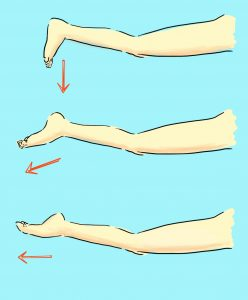
The other thing I noticed, and I think it’s tightly linked to the above issue, is my lack of power when I leg kick.
I’ve done several groups lessons with a swim coach, to improve my technic. We were around 10 people at each lessons, and we quickly saw that 3 of us (me included) were a bit more experienced swimmer (we could average 2:00 / 2:15 min /100m), and we were able to swim for a few laps before getting exhausted easily. The rest of the group had learned to properly swim more recently and were still learning basics, so they were much slower (no judgement here, it’s just to give you a good picture of the group we had).
Well, I had no problem catching the other 2 when we were doing some drills, however, whenever we were asked to leg kick only, for example to warmup at the beginning, I was completely unable to keep up. Instead, the other group was catching up pretty easily on me, and even they wondered why I was so slow when doing leg kick only !
Later on, we had some exercises where we had to put fins. Oh my the difference was huge, it felt amazing to swim with theses. It’s like having a turbo mode activated. And this is were it struck me : I do not use more power when I’m wearing fins, it just have a way bigger surface to catch water. Since I’m unable to stretch my ankle correctly, not only it creates drag because my body is no longer a straight line, but it can’t grab much water. The lack of meat in my calfs also doesn’t help : a generally reduced surface to push water.
Luckily legs in swimming are not used to generate much speed, but their jobs is to provide stability and follow the rhythm given by your arms, so it’s not a huge issue for me. But I find it interesting how it impact my swimming in a very specific way :-). One other thing worth noticing : you constantly learn new things about yourself, even approaching 30 years old.
How it feel like to cycle with clubfeet
Cycling might be the sport where having clubfeet affects the less. There might be only one thing that makes it a bit harder : When pressing down on the pedals, your heel is supposed to be lower than your front foot/toe on the pedals.
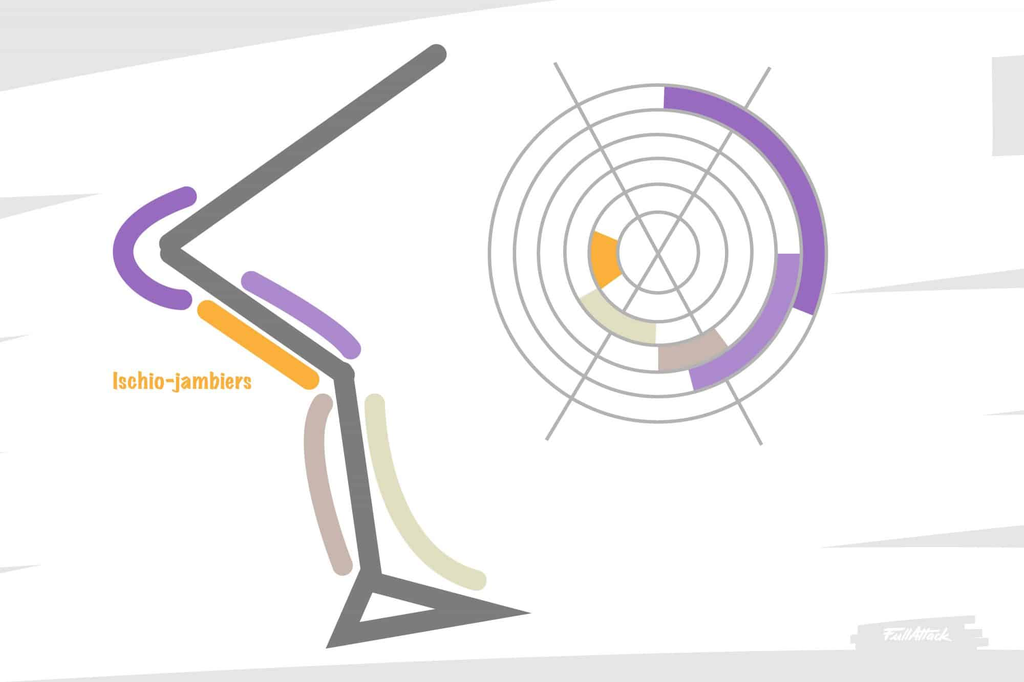
By having the heel as low as possible, you will engage more the bigger muscles when pedaling down. There is a great article (in french) on full attack about this : https://fullattack.cc/transmission-et-biomecanique/.
This is a bit harder to do when you have low mobility, however I clearly doesn’t see it as a big problem here.
How it feel like to run with clubfeet
Clearly this is were the bigger issues are happening. Since I have :
- Low strength in the calf
- Low mobility of the ankle
My muscles can’t provide the shock absorptions I need, so my inner bones are getting hammered a little bit on each footstep. This is aggravated in my ankle, since it has low flexibility, I’m rapidly in the end of the mobility “range” and my inner-bones are more likely to shock among themselves by default, even when not running. So this is a lose-lose situation.
Depending on the distance and the intensity of the running session, those issues goes from being a little sore/ having some stiffness in the afternoon or the next day, to being unable to properly walk after a half-marathon during several days.
There is also a heated debated on how you should land when you’re running, there is basically three way :
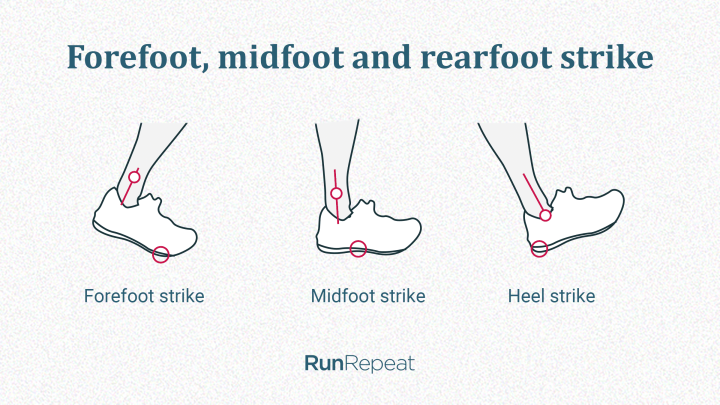
I won’t detail here what’s best, what you should do or not do… but what is sure : the vast majority of people are heel-strikers, and this is made possible due to modern running shoes, that have a huge amount of shock absorption on the heel.
Bare foot runners (yes, this is a niche trend) usually don’t do this because naturally we can’t absorb shocks well with our heels. What we do naturally when we’re running without shoes, is to land on the middle or the front font, and use our muscles and tendons to absorb the shock.
Well, this is mostly impossible for clubfoot people, or at least me. I mean, I just don’t have the force available to absorb the shock, so heel striking is mandatory
Is there a way to change or improve something ?
I look at this this way : we all have a range of possible improvement, in all domains, sport or not, disease or not. Things are getting unfair between individuals on how big the possible progress is though.
Regarding my 3 main mechanical problems :
- Muscular power in the calf
- Ankle front flexion
- Proprioception
I believe that if I stop all sort of physical activities, I will lose a bit of each capacity, so that means that I have a certain tiny amount of progress. But drastically improve one of this aspect ? Mmh, at first not so possible. Or maybe there is something :
This year, I decided to consult a surgeon to perform a general check-up of my feet, check what was possible to do and take time with him since the last time a specialist looked at my feet was 12 years ago.
I simply described him the above symptoms and problems I had, and he quickly proposed a solution : an ankle arthroscopy. The goal is to improve ankle flexion by removing some bones that are hitting against themselves when I’m in full front flexion.
This is it for this post, I will dedicate one detailing the operation, the recovery process, and I hope : the difference I will feel once fully recovered 🙂


Leave a Reply